Knowing Too Many Techniques Slows the Shooter Down: Brown Belt Syndrome and the "Decision Stick"
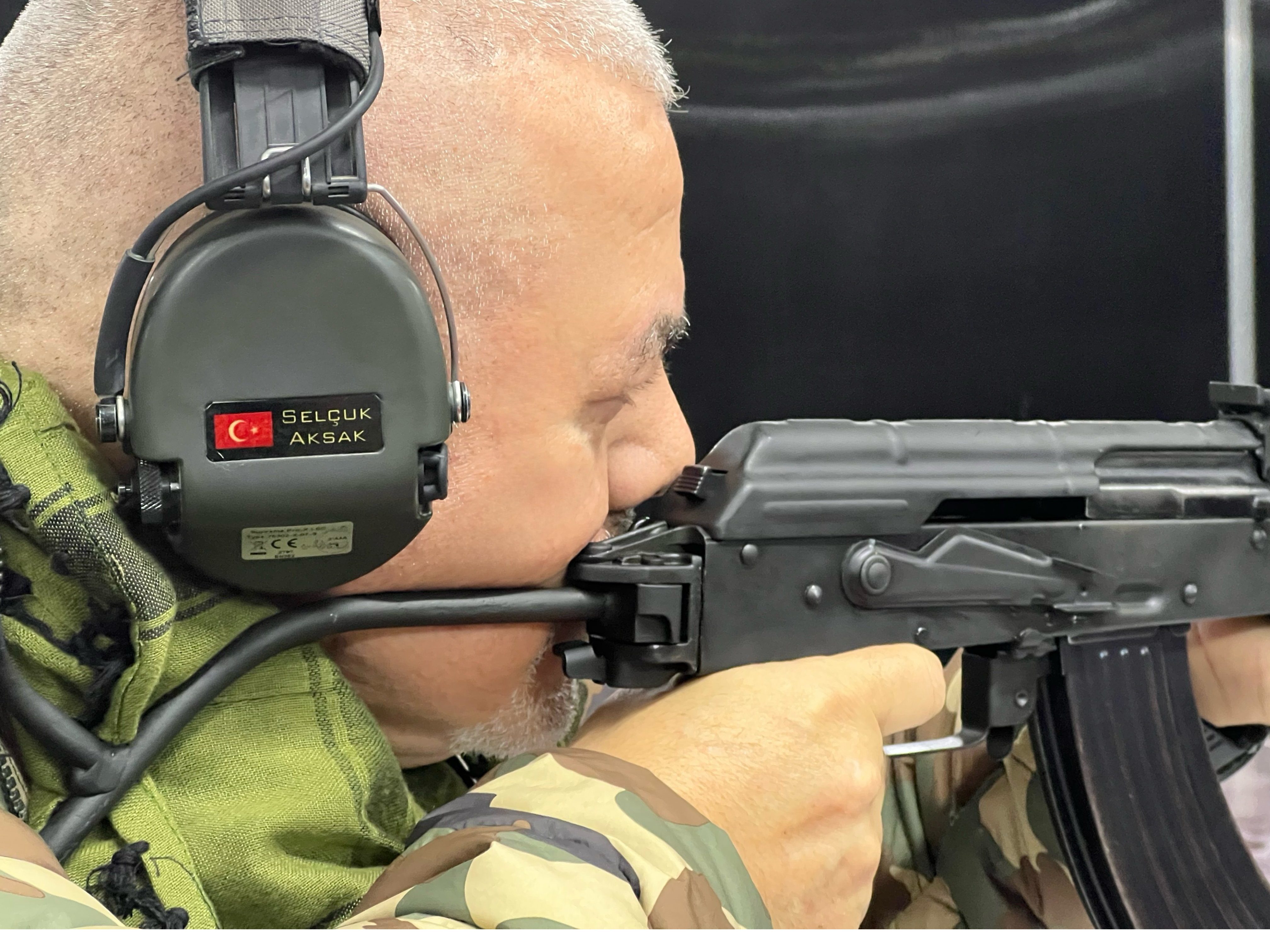

The certificates on the wall may be making people slower
Every newly learned technique, every newly earned certificate, gives the impression of a margin of safety: a repertoire acquired so that it will be there if needed one day. But the way the human decision-making mechanism actually works reverses this intuition directly: the larger the repertoire grows, the longer it takes to access it. The claim of this article is simple and may be uncomfortable to hear: having thirty different responses on hand against a single threat does not make a person prepared, it makes them slow. The reason is not a lack of discipline; it is a measured and repeatedly replicated law of the human nervous system.
This claim does not originate with motivational speakers. Rory Miller, who worked for more than twenty years as a corrections officer and tactical team instructor in an American state prison and personally experienced dozens of real physical confrontations, lays it out in Section 2.6 of Meditations on Violence: A Comparison of Martial Arts Training and Real World Violence (2008), combining his own field observations with a well-established finding from cognitive psychology. This article follows the line that section opens: an account of why knowing more can be more dangerous than knowing less, the mechanism behind it, and what can be done about it.
"Brown Belt Syndrome"
A familiar scene exists in the martial arts and tactical training community: the beginner confidently applies the three or four techniques they know, and it usually works. But as they progress toward brown belt, toward "operator" level, toward a third or fourth certification course, their technical repertoire grows. Each new course adds a new variant, a new "better" solution. Oddly enough, in a genuine moment of pressure, this more experienced, more "well-equipped" person sometimes performs worse than the beginner. Miller calls this "Brown Belt Syndrome": he argues that knowing too many "cool" techniques opens the door to defeat while trying to pick the right one.
This is not a matter of laziness or lack of discipline. It is the direct result of a mathematical relationship between the number of options and decision time.

Hick's Law: As Options Increase, Time Is Lost
In 1952 William Edmund Hick, and then in 1953 Ray Hyman, established through a simple experiment one of the most robust and most replicated findings in cognitive psychology (Hick, 1952; Hyman, 1953): as the number of options presented to a person increases, so does the time needed to select the correct response, and not linearly but logarithmically (reaction time ≈ proportional to log₂ of the number of options). Choosing between two options is far faster than choosing between eight; but doubling the number of options does not double the decision time, it adds a fixed additional amount. This finding is so robust that it is known in the literature by its own name: the
Hick-Hyman Law.
A degree of scientific honesty is owed here, because an exaggerated popular version of this claim circulates. Hick and Hyman's original experiments were conducted on simple, discrete, predefined stimulus-response pairings, such as pressing buttons in response to lights in a laboratory, not on complex, multi-joint, highly automatized motor sequences such as drawing a pistol from a holster or a knife flourish. In the hands of an expert shooter or fighter, a well-consolidated technique no longer operates as "a choice among options" but as a single "chunk" (an integrated motor program); at that point, Hick's Law's classic laboratory finding may not hold in precisely the same form. Proctor and Schneider's (2018) comprehensive review treats the question of how repetition and practice alter the law's prediction as one still debated among scientists; in other words, this is not an arbitrarily raised objection but a limitation the literature itself acknowledges. But the mechanism Miller proposes absorbs this objection as well: the problem is not "is each technique on hand well-consolidated," the problem is that the question "which technique should I use" itself creates a moment of choice, that is, a Hick-type decision point. However well-consolidated the technique may be, the moment the question "A or B or C" is asked under pressure, fractions of a second are lost; in a real confrontation, fractions of a second separate those who survive from those who do not.

Chunking: Why a Well-Consolidated Technique Does Not Count as an "Option"
The resolution of the objection above lies in a well-established model from the motor learning literature. The three-stage model of skill acquisition (cognitive stage, associative stage, autonomous stage) proposed by Paul Fitts and Michael Posner in Human Performance (1967) describes how a movement transforms from "a thought requiring a choice" into "a single, unitary reflex." A movement that has reached the autonomous stage no longer consumes conscious attentional resources; neurologically it is stored as a single unit, a "chunk," and fires as a whole once triggered. This never enters into Hick's Law's "number of options" variable, because it is no longer an option, it is a single output.
This sharpens Miller's "meta-strategy" proposal on scientific grounds: the problem is not that an individual technique is poorly consolidated (that is a separate problem in its own right: insufficient repetition). The real problem is that, however well-consolidated they are, numerous competing chunks are attached to the same higher-level intent. Even with ten perfectly consolidated wrist-lock variants on hand, the question of "which one to use" remains a Hick-type moment of choice at the higher level. The "decision stick" resolves exactly this: what is selected at the higher level is not a technique but an intent ("defang the snake"), and which specific chunk fires beneath that intent is decided not by conscious thought but by the geometry of the situation (distance, angle, grip); this is no longer a Hick-type serial decision but the motor system's own automatic selection.

The OODA Loop: Where the Time Is Lost
Miller connects this finding to Colonel John Boyd's OODA loop (Observe–Orient–Decide–Act), a framework Boyd never formally published but which became the standard reference in the military and strategic literature through the "Patterns of Conflict" briefing and the posthumously compiled A Discourse on Winning and Losing (ed. Grant T. Hammond, 2018). In Boyd's model, every decision passes through a four-step loop, and whichever side completes this loop before its opponent holds the advantage. Miller's field observation is clear: time is lost mostly in the two middle steps of the loop, Orient and Decide. Observe and Act are comparatively fast; the real bottleneck lies in working out what was observed and then deciding what to do about it.
The tactical consequence of this is severe: an attacker's Act step is the trigger for the defender's Observe step. By the time the attacker launches the attack, they are already at the fourth step of their own loop, while the defender is still at the first. The defender starts a full cycle behind. If this already-behind party is also trying to choose among thirty techniques at the Decide step, that gap does not close; it widens instead.
For a military or law enforcement reader, this maps onto familiar doctrinal language: shortening the OODA loop is something far beyond the classic advice to "improve observation skills"; it means narrowing the loop's two middle steps, that is, simplifying the decision tree. The same logic holds for the competitive shooter: hesitation on a stage usually does not occur during aiming, it occurs in answering the question of "in what order, with what technique, the target will be engaged."

The Solution: Reducing the Decision Tree to a "Decision Stick"
The solution Miller proposes is not less training; it is changing the architecture of what is trained. He calls this a "meta-strategy": rather than storing dozens of different techniques as separate options that must be compared, he proposes encoding all of them into a single, integrated response. Miller's own examples are: "defang the snake," a single set of movements focused on disabling the attacker's weapon or weapon-bearing limb (usually the hand or arm); "take the center," a single set of movements that establishes positional and balance superiority; and "do damage," a single set of movements aimed directly at incapacitation.
Each of these is in fact an umbrella intent under which dozens of specific techniques (a wrist lock, an elbow strike, a chest push, a leg sweep) are gathered. The critical point is this: under pressure the brain does not choose between "wrist lock or elbow strike"; it selects the single intent "I need to defang the snake," and the body automatically produces whichever previously consolidated motor program fits that intent. Miller sums this up with the metaphor of the "decision stick": rather than a many-branched decision tree, it is a single-branched stick. Once the point of choice is reduced to three or four intents, the Hick-type delay shrinks proportionally.
This aligns directly with the Recognition-Primed Decision (RPD) model described by Gary Klein in Sources of Power: How People Make Decisions (1998): genuine experts (fire commanders, pilots, military commanders) do not compare and score options during a crisis; they match the situation to a familiar pattern and apply the first reasonable action that comes to mind. Miller's "decision stick" and Klein's "pattern recognition" are views of the same principle from two different disciplines: expertise is not about increasing the number of options, it is about reducing the number of options needed at the moment they are needed.
The Opponent Has the Same Weakness: Deliberately Breaking the OODA Loop
The second, less-discussed half of Miller's analysis in the book is this: if an excess of options can freeze a person, the same mechanism can be used to freeze the opposing side. He summarizes this in five points:
Unidentifiable stimuli lock people up. Someone confronted with an unexpected situation that cannot be categorized gets stuck on the question "what is this"; this too is a Hick-type delay, but this time deliberately created.
One must be able to act on incomplete information. A side that waits for complete information never finishes its loop.
Someone who has a plan freezes when the plan breaks down. The more detailed and rigid the plan they are attached to, the more paralyzing an unexpected deviation becomes.
Continuous pressure (barrage) keeps resetting the opponent's loop. With every attempt to recover, the opponent returns to the Observe step and never reaches Act
The countermeasure is to develop a self-referential trigger. It means turning the very moment of "I feel myself freezing" into an automatic signal to switch into a counter-action, without waiting for an external cue.
These five points show two sides of the same coin: narrowing one's own decision tree speeds a person up, while widening the opponent's decision tree, deliberately or not, slows them down. The same law operates in both directions.
It is useful to look at how this principle shows up in two different domains. On the military and law enforcement side, the first second after a CQB (close-quarters battle) team breaches a door is shaped exactly by these five points: a team that does not know what it will find inside (point 1), must act on incomplete information (point 2), and carries a freezing risk if there is a deviation from the pre-built scenario (point 3). Well-trained teams resolve this with a small, fixed decision stick along the lines of "what to do in the first three seconds regardless of room type"; the decision tree stays the same even if the room's contents change.
In competitive shooting, the same mechanism is embedded in stage design itself. A well-designed IPSC/IDPA stage is built specifically to produce "unidentifiable stimuli" and "plan disruption" (points 1 and 3): an unexpected no-shoot target, a concealed obstacle, a visual barrier that becomes active with a bang triggered by a sound, a port position that breaks the standard sequence. A shooter who rehearses dozens of alternative routes and techniques in their mind during the stage walk-through gets caught precisely in that unprepared moment the instant the timer starts; hesitation becomes directly visible in the split times. The stage timer is therefore one of the most objective instruments for measuring Hick-type delay: most of the transition-time difference between two equally skilled shooters comes not from muscle speed but from the width of the decision tree.
Counter-Argument: "Should One Never Learn a New Technique?"
Honesty is required at this point, otherwise the claim collapses into a caricature. Another robust finding from the motor learning literature, variability of practice, shows that training with a wide movement repertoire increases long-term transferability and adaptability. The advice "learn fewer techniques," taken literally, contradicts its own evidence base.
This apparent contradiction actually stems from a category error. This article's claim is directed not at the breadth of training, but at the breadth of the "live" decision menu. Trying dozens of variants in the dojo, on the range, in a force-on-force scenario, and discovering which one fits the body and the situation, is precisely how expertise is built, and it is indispensable. The problem is never performing the elimination at the end of that exploratory process: trying to keep all thirty variants tested in training in the "usable in the real moment" category. In Gary Klein's RPD model as well, experience turns into expertise not by increasing the number of options but by building more accurate, fewer matches between which pattern pairs with which response. Breadth should stay in training; what is carried to the field, to the range, to the real moment should be a winnowed, narrowed "decision stick."
This need for elimination is not unique to technique; it operates the same way in equipment layout. On a scenario course, the same weakness shows up not in technique but in equipment layout: the access angle and positioning ergonomics of magazines on a mounting platform is an area where several different placement schemes get tried and none is ever definitively settled on in training. The result is that the umbrella intent falls short this time not in technique but in equipment use: every forced magazine change mid-course is not the execution of a decision already made, it is a live Hick-type choice.
Three Audiences, Three Different Conclusions
For military and law enforcement readers, this is the cognitive explanation for a familiar doctrinal principle: it is why rules of engagement and standard operating procedures are built not around "a response for every contingency" but around "a small, well-consolidated response set." Simplification is not laziness; it is speed engineering.
For the competitive shooter, this is a direct challenge: acquiring a new course every year, a new "better" transition technique, a new draw-from-the-holster variant, and especially training by weighing each against the old one to determine "which is better," can worsen stage performance rather than improve it. The culture of acquiring equipment and technique (a new certificate, a new "grip," a new stance school contradicting what was taught in the previous course) builds exactly the scenario Hick's Law predicts: a pile of competing options that must be compared under pressure.
Behind this tendency toward acquisition there is often a commercial, not a pedagogical, logic: a segment of instructors has emerged that wants to grow its student pool and packages and sells every new method, needed or not, as "this will contribute to the student's development." That sentence is not a learning rationale; it is a sales pitch. The bill for it is paid not by the instructor but by the student who is forced to choose among that extra branch at the moment of a real threat.
The shared conclusion: the question should not be "how many techniques do I know" but "how many competing options do I have on hand under pressure." Growing the technical repertoire is safe only on the condition that the old is eliminated and the new is put in place of it, not added on top of it. Otherwise every new certificate becomes a burden that produces a sense of security while actually lengthening reaction time.
A representative (fictional, not based on any specific person or event) example can make this concrete. The first shooter learned a single method for drawing from the holster and has repeated it ten thousand times. The second shooter, over the last three years, learned four separate "more efficient" holster-draw methods across four different courses and drilled each one a few hundred times. The second shooter's total repetition count may be higher; but at the critical moment (par-time pressure, a sudden threat, fatigue), that shooter's nervous system is forced to make an implicit choice among which of the four competing motor programs will fire. This choice produces a measurable delay even when it is not conscious; the shooter saying "I don't feel like I'm choosing, I'm doing it automatically" does not change this, because the delay comes not from conscious awareness but from the implicit arbitration the nervous system performs among competing programs. For the first shooter, no such moment of choice exists, because there is no competitor; when there is no second thing to choose, no arbitration is needed either.
utting It Into Practice: How to Build a "Decision Stick"
There is a concrete path from theory to practice, in three steps:
1. Take inventory. For a given threat category (a close-range weapon threat, a stoppage during a transition, a surprise encounter in an enclosed space), it should be listed honestly how many competing responses are currently on hand. For most experienced practitioners, this number turns out higher than expected.
2. Reduce to umbrella intents. An umbrella intent reduces the shared goal of dozens of competing techniques to a single higher-level decision; the choice stops there and never descends to the technique level. Rather than comparing the list item by item, it should be grouped into three or four higher-level intents, as in Miller's example ("close the distance," "break the line," "disable the weapon"). More than one technique may fall under each intent; this is not a problem, because the choice is now at the intent level, not the technique level.
3. Move the moment of choice out of training and into preparation. The decision about which intent applies to which situation should be made in advance, calmly, on the range or in the dojo. The only thing that should happen under pressure is execution, not choice.
Closing: The Number of Certificates on the Wall Is the Wrong Metric
The assumption that "the more you know, the more prepared you are" is so deeply embedded in the training community that saying the opposite runs against that system's own self-interest. But the experimental finding of Hick's Law and the clinical observation Miller draws from dozens of real confrontations converge on the same point: what saves a person in a real crisis is not the size of the repertoire, but how quickly it can be accessed. That access speed is inversely proportional to the number of options stored.
The real question is this: do the certificates on the wall actually add speed, or do they merely produce a feeling of being "prepared"? These are not the same thing; the difference shows up precisely in that quarter second when the trigger has to be pulled.
Author
Dr. Selcuk Aksak
Shooting Sport Instructor & Coach
IDPA Certified Safety Officer / Licensed Gunsmith
Burkut Academy, Istanbul, Turkey
References
Miller, R. (2008). Meditations on Violence: A Comparison of Martial Arts Training and Real World Violence.YMAA Publication Center. [Chapter 2.6]
Klein, G. (1998). Sources of Power: How People Make Decisions. MIT Press.
Hick, W. E. (1952). On the rate of gain of information. Quarterly Journal of Experimental Psychology, 4, 11–26.
Hyman, R. (1953). Stimulus information as a determinant of reaction time. Journal of Experimental Psychology, 53, 188–196.
Proctor, R. W., & Schneider, D. W. (2018). Hick's law for choice reaction time: A review. Quarterly Journal of Experimental Psychology, 71(6), 1281–1299.
Fitts, P. M., & Posner, M. I. (1967). Human Performance. Brooks/Cole.
Boyd, J. R. Patterns of Conflict (briefing, 1976–1986, never formally published); compiled edition: Hammond, G. T. (ed.) (2018). A Discourse on Winning and Losing. Air University Press.




Comments