The 80,000 PSI Threshold Implications of Federal Premium Peak Alloy Technology on Interior Ballistics, Barrel Harmonics, and the Future of Ammunition Engineering


Abstract: This article examines Federal Premium's Peak Alloy technology not merely as a new ammunition product, but through a systematic analytical framework encompassing engineering parameters, claim verifiability, and the absence of independent validation. The mechanical constraints that have determined brass's 130-year hegemony, the materials science foundations of the steel-alloy case, the interior ballistic implications of 80,000 PSI operating pressure, barrel harmonic shift mechanisms, and system-level mechanical risks are addressed in turn. Federal's core claims are evaluated against an evidence-level classification scheme, and domains requiring independent verification are explicitly identified.
SECTION 1: Historical Development of Case Technology
1.1 From Black Powder to the Modern Cartridge

In the early period of firearms technology throughout the fifteenth and sixteenth centuries the concept of ammunition differed fundamentally from its contemporary form. Propellant, projectile, and ignition components were loaded separately, requiring manual muzzle loading before every shot. In the first half of the nineteenth century, the development of the metallic cartridge constituted a genuine paradigm shift in firearms engineering. Between 1845 and 1860, the earliest cartridges manufactured from copper and brass alloys unified propellant gas containment, ignition, and extraction into a single unit. This integration dramatically increased the rate of sustained fire and opened the path to modern rifle design.
1. Hatcher, J.S. (1947). Hatcher's Notebook. Military Service Publishing.
1.2 Boxer and Berdan Systems

The two foundational architects of modern cartridge technology are British Colonel Edward Boxer and American Hiram Berdan. Both systems were developed in the 1860s, yet diverge fundamentally in structural approach. The Berdan system incorporates two flash holes and an integral anvil in the case head; manufacturing costs are lower, but spent primer removal is mechanically demanding and precludes convenient reloading. The Boxer system, by contrast, employs a single flash hole and a removable primer cup with a separate anvil, enabling reloading. This property confers a critical advantage in precision shooting disciplines, where case geometry repeatability is a direct determinant of ballistic consistency.
Historical and engineering record. Source: Watrous (1943).
2. Watrous, G.D. (1943). The History of Winchester Firearms. Winchester Press.
1.3 Brass as the Standard Material

By the late nineteenth century, various metals had been evaluated as case materials. Brass the alloy of approximately 70% copper and 30% zinc demonstrated an unrivalled engineering profile. Three mechanical properties underpin its selection: (1) Obturation behaviour: under the elevated temperature and pressure of firing, brass undergoes controlled plastic deformation that conforms the case body to the chamber geometry, achieving gas seal without a mechanical gasket. (2) Elastic recovery: as pressure drops following firing, brass recovers towards its original dimensions, facilitating extraction. (3) Machinability: brass can be deep-drawn to exceptionally tight tolerances, a prerequisite for ballistic repeatability.
Property | Brass CuZn30 | Mild Steel | Aluminium 6061 |
Young's Modulus (GPa) | 100–110 | 200–210 | 68–70 |
Yield Strength (MPa) | 75–300* | 250–400 | 275 |
Tensile Strength (MPa) | 300–500 | 400–550 | 310 |
Elastic Recovery | High | Low | Moderate |
Corrosion Resistance | Excellent | Poor | Good |
Machinability | Excellent | Moderate | Good |
*Varies with cold-work ratio. Source: ASM Handbook, Vol. 2 (2005). ASM International materials database.
3. ASM International (2005). ASM Handbook, Volume 2. 4. SAAMI (2015). Voluntary Industry Performance Standards.
1.4 System Lock-In: Why Did Nothing Change for 100 Years?

Viable technical alternatives to the brass case have existed for decades. Yet standards bodies, manufacturing infrastructure, test protocols, and the broader industrial ecosystem crystallised around brass. This century-long lock-in effect transformed brass from a mere material into the epistemic framework of ammunition engineering. Replacing a material is insufficient; replicating an entire system is required. This context is precisely what renders Peak Alloy technically significant.
David, P.A. (1985). Clio and the Economics of QWERTY. American Economic Review, 75(2), 332–337.
SECTION 2: Mechanical Limitations of Brass Cases
2.1 Forces Applied to the Case at Firing

Upon firing, the case is subjected simultaneously to three primary mechanical loads: axial pressure (propellant gas forces radial expansion of the case walls), axial tension (as the projectile accelerates forward, the case head is driven rearward), and thermal loading (combustion gas temperatures reach 2,500–3,500°C). The resultant combination of these forces activates four critical damage mechanisms.
Vaughn (1998), SAAMI technical documentation.
2.2 Primary Damage Mechanisms

Case Head Expansion
With each firing, the case head expands by incremental plastic deformation at the micron scale. This deformation is cumulative and irreversible. A post-firing increase in head diameter exceeding 0.001 inch (0.025 mm) is the recognised indicator of plastic flow onset.

Primer Pocket Enlargement
adial loading of the primer pocket over successive firings progressively reduces primer retention. Advanced enlargement results in primer gas leakage and presents a safety hazard. In reloading practice, a loose primer condition is the standard criterion for case retirement.

Incipient Case Head Separation
Internal cracking initiated in the web region the transition between the case head and the cylindrical body is not externally visible; detection requires the wire hook method. Complete case head separation results in a high-pressure gas breach and potentially severe weapon damage.
2.3 The 65,000 PSI Ceiling
Cartridge | MAP (PSI) | MAP (MPa) | Year |
.308 Winchester | 62,000 | 427 | 1952 |
6.5 Creedmoor | 62,000 | 427 | 2007 |
.300 Winchester Magnum | 64,000 | 441 | 1963 |
6.5 PRC | 65,000 | 448 | 2017 |
.300 PRC | 65,500 | 451 | 2018 |
6.8 NGSW (reference) | ~80,000 | ~552 | 2022 |
A consistent pattern emerges from this table: new cartridge designs over the past seven decades have not meaningfully exceeded this ceiling. The 6.5 PRC and .300 PRC, developed in the late 2010s, remain immediately below 65,000 PSI. This limit reflects the mechanical transition threshold of the brass case specifically, the point at which yield strength degrades under thermal loading and plastic deformation becomes irreversible, compromising dimensional repeatability and, consequently, ballistic consistency.
SAAMI (2015). Voluntary Industry Performance Standards, Table 1.
7. Vaughn, H.R. (1998). Rifle Accuracy Facts. Precision Shooting Inc. 8. SAAMI (2015). op. cit.
SECTION 3: Materials Science of Peak Alloy Technology
3.1 Scientific Assessment of Federal's Claims

Federal Premium advances five principal claims for Peak Alloy technology. As of the date of this article, all of these claims rest exclusively on Federal's own technical and marketing materials and have not been validated by independent peer-reviewed studies.
This distinction is maintained throughout the article.
Federal Claim | Physical Plausibility | Independent Validation |
80,000 PSI operating capacity | Theoretically feasible | None available |
~300 fps muzzle velocity gain | Plausible upper bound | None available |
Comparable barrel life | In tension with thermodynamics | None available |
Compatibility with existing platforms | Fatigue data absent | None available |
Accuracy improvement | Indirect mechanism possible | None available |
3.2 Steel Cases: Historical Context
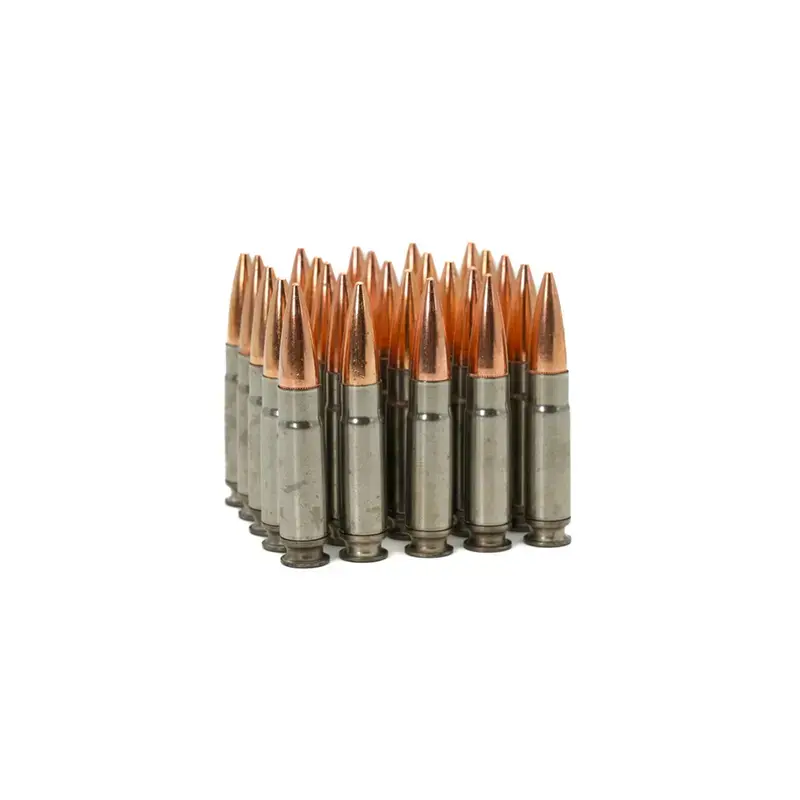
The use of steel cases is not Federal's invention. During the Second World War, Germany and the Soviet Union produced steel cases at scale as a consequence of brass shortages. However, these wartime steel cases were beset by poor obturation, high extraction friction, susceptibility to corrosion, and brittle behaviour at low temperatures. These limitations did not render steel technically impossible they indicated that the metallurgy of the era was insufficient to overcome brass's standardise performance profile. Ezell, E.C. (1983). Small Arms of the World. Stackpole Books.
3.3 Material Comparison
Parameter | Brass CuZn30 | Low-Alloy Steel | Peak Alloy (Federal) |
Young's Modulus (GPa) | 100–110 | 200–210 | ~200 |
Yield Strength (MPa) | 75–300* | 350–700 | >500 (est.) |
Tensile Strength (MPa) | 300–500 | 500–900 | >700 (est.) |
Thermal Expansion (μm/m°C) | 19–21 | 11–13 | ~12 |
Corrosion Resistance | Excellent | Poor–Moderate | Good (with coating) |
Peak Alloy column derived from Federal technical materials and inferential estimation.
3.4 Critical Engineering Parameters
Young's Modulus A Twofold Difference
Peak Alloy's Young's modulus is approximately twice that of brass (~200 GPa vs ~105 GPa). Brass conforms to the chamber by plastic flow; a stiffer steel alloy must achieve the same seal through elastic strain. The mechanism by which Federal resolves this fundamental difference has not been disclosed publicly.
Fatigue Behaviour
High-strength steels can, under certain conditions, exhibit more abrupt fatigue fracture than brass. Whether Peak Alloy cases are suitable for handloading has not been explicitly stated by Federal a question of material practical concern to the precision shooting community. [Probable risk]
10. Ezell, E.C. (1983). op. cit. 11. ASM International (2005). ASM Handbook, Vol. 1. 12. US Patent Database Federal Cartridge Co., 2018–2023.
SECTION 4: Interior Ballistic Significance of 80,000 PSI
4.1 The Interior Ballistic Cycle
Interior ballistics describes the sequence of physical events from the instant of ignition until the projectile exits the muzzle. The cycle comprises primer ignition, propellant combustion (deflagration not detonation), peak pressure, projectile acceleration, and barrel exit. The pressure-time (P-t) curve is the most comprehensive summary of the system; the integral beneath the curve is directly related to the total impulse imparted to the projectile.
McCoy, R.L. (1999). Modern Exterior Ballistics. Army Research Laboratory (2003). ARL-TR-2997.
4.2 Comparative Analysis: 65,000 PSI vs 80,000 PSI
Parameter | 65,000 PSI (Brass) | 80,000 PSI (Peak — Claimed) | Verification Status |
MAP | 65,000 PSI | 80,000 PSI | Federal data only |
MV Gain | Reference | +~300 fps | Unverified |
Barrel Time | Reference | Shorter (theoretical) | Inferential |
Heat Flux | Reference | Higher | Thermodynamic necessity [Established] |
Barrel Life | Reference | "Comparable" (claimed) | Unverified |
Recoil Impulse | Reference | Higher | Thermodynamic necessity [Established] |
4.3 Federal's ~300 fps Claim: Physical Assessment
The reference muzzle velocity for standard 6.5 Creedmoor with a 142-grain projectile is approximately 2,700 fps from a 24-inch barrel. A gain of 300 fps represents approximately 11% velocity increase. This figure is physically plausible but lies at the upper bound of what could be expected from a pressure increase alone. Realising this gain requires optimised propellant formulation; the case change alone cannot deliver this increment independently.
Theoretically consistent no independent chronograph data available.
4.4 The Thermodynamic Cost of Higher Pressure
A system operating at 80,000 PSI transfers substantially greater thermal energy to the barrel steel than one operating at 65,000 PSI. This increase is cumulative and accelerates throat erosion. Federal's claim of comparable barrel life appears to be in tension with this physical necessity. Two mechanisms could in principle resolve the contradiction: either Peak Alloy's lower thermal conductivity reduces heat transfer to the barrel relative to brass, or the propellant formulation has been engineered for lower flame temperature. Neither mechanism has been disclosed by Federal.
Independent thermal measurement is required before this claim can be assessed.
13. McCoy, R.L. (1999). op. cit. 14. Army Research Laboratory (2003). Interior Ballistics of Guns. ARL-TR-2997.
SECTION 5: Barrel Harmonics and the Effects of Elevated Pressure
5.1 Why Does a Barrel Vibrate?
A rifle barrel is mechanically modelled as a cantilever beam fixed at the receiver end, free at the muzzle. At firing, the superposition of internal pressure loading, projectile-bore friction, recoil reaction, and thermal gradient initiates vibration at the barrel's characteristic natural frequencies. Vibration occurs in three modes: lateral vibration (whip motion the mode most directly affecting precision), axial vibration, and torsional vibration.
Timoshenko, S. & Young, D.H. (1955). Vibration Problems in Engineering. Van Nostrand.
5.2 The Harmonic Window: Practical Significance
When the projectile exits the muzzle at or near a nodal point of the standing wave a position of minimum vibration amplitude muzzle displacement is minimal and grouping is optimised. This condition defines the harmonic window: a specific range of barrel dwell times within which the exit phase is favourable. The empirical practice of load development incrementally adjusting charge weight to minimise group size constitutes, in physical terms, a search for this window.
Vaughn, H.R. (1998). Rifle Accuracy Facts. Chapters 4–6.
5.3 Original Contribution of This Article: Four Critical Questions
The effects of Peak Alloy on barrel harmonics have not been addressed in any independent study. This article constitutes the first systematic scientific formulation of this question.
Question | Theoretical Answer | Evidence Level |
Does 80,000 PSI alter vibration frequency? | No frequency is determined by barrel geometry | Probable |
Does it shift nodal points? | No but barrel time shift alters exit phase | Probable |
Can shorter barrel time improve precision? | Indeterminate combination-dependent | Speculative |
Could it narrow the harmonic window? | Potential risk steeper P-V curve | Speculative |
5.4 Practical Implications for the Precision Shooter
Transitioning to Peak Alloy ammunition invalidates existing load development data. A charge weight optimised for a brass case will not produce the same harmonic phase with Peak Alloy retuning is mandatory. Additionally, if the narrow harmonic window hypothesis is correct, performance variability at low ambient temperatures may increase; this is a critical operational parameter for military applications.
Precise prediction requires independent experimental data.
16. Timoshenko & Young (1955). op. cit. 17. Vaughn (1998). op. cit. 18. Varmint Al (2005). Barrel Vibration and Accuracy. 19. Litz, B. (2011). Applied Ballistics for Long Range Shooting.
SECTION 6: Peak Alloy Technology and Precision Shooting
6.1 Performance Metrics: Conceptual Clarity

In precision shooting, precision and accuracy are distinct concepts. Precision denotes the clustering of successive impacts; accuracy denotes proximity to the point of aim. Peak Alloy may theoretically improve precision through reduced extreme spread, lower standard deviation, and enhanced case dimensional stability. Its effect on accuracy is indirect it enhances the reliability of zero and hold-over calculations. Vertical dispersion is primarily a function of muzzle velocity variability; horizontal dispersion is principally governed by barrel harmonics. This distinction is central to a rigorous evaluation of Peak Alloy's performance claims.
6.2 Ballistic Profiles of Three Cartridges
Parameter | 6.5 Creedmoor | 6.5 CM +Peak (Claimed) | 6.5 PRC |
MAP (PSI) | 62,000 | ~80,000 | 65,000 |
Muzzle Velocity* (fps) | 2,700 | ~3,000 | 2,950 |
Muzzle Energy* (ft-lbs) | 2,283 | ~2,830 | 2,750 |
BC (G7) — 140 gr | 0.301 | 0.301** | 0.315*** |
Transonic Range (yds) | ~1,200 | ~1,350 | ~1,400 |
Barrel Life | 2,500+ | "Comparable" (claimed) | 1,500–2,000 |
24-inch barrel, 140-grain projectile. *Same projectile BC is invariant. ***6.5 PRC is typically paired with higher BC projectiles.
Peak Alloy column: Federal claims only no independent validation.
6.3 BC Invariance: A Frequently Overlooked Point
A projectile's ballistic coefficient is determined by its geometry and mass not by muzzle velocity. When a 140-grain 6.5 mm projectile is fired from 6.5 Creedmoor +Peak, its BC is identical to that of the same projectile launched from standard 6.5 Creedmoor. Higher initial velocity defers the transonic transition but does not eliminate the stability challenges inherent to that regime. Deferring the transonic transition and improving transonic stability are distinct outcomes; the latter is governed principally by projectile design.
BC physics is well-established. The relationship between Peak Alloy and transonic stability remains unexamined.
6.4 Temperature Sensitivity: An Overlooked Variable
In a system operating at 80,000 PSI, the steeper pressure-velocity curve implies that temperature-induced pressure variation produces greater velocity excursion than in a conventional brass-case system. The effect of a 70°C ambient temperature range (from −20°C in Northern European winter to +50°C in Middle Eastern summer) on Peak Alloy performance consistency has not been examined in any publicly available study.
Theoretical risk independent testing is critical for military qualification.
20. Litz, B. (2015). Accuracy and Precision for Long Range Shooting. 21. McCoy, R.L. (1999). op. cit. Chapter 8.
SECTION 7: Barrel Life and Erosion
7.1 Federal's Most Contested Claim
Federal asserts that Peak Alloy delivers barrel life comparable to standard brass cases despite operating at 80,000 PSI. Current thermodynamic knowledge renders the verifiability of this claim questionable; it cannot be accepted in the absence of independent experimental evidence. This assessment does not assert that the claim is necessarily false a specialised propellant formulation or an unexpected advantage in the case's thermal behaviour could resolve the apparent contradiction but the explanatory mechanism is a scientific obligation, not an optional disclosure.
7.2 Four Erosion Mechanisms
Mechanism | Description | Effect at 80,000 PSI | Peak Alloy Relationship |
Thermal Erosion | High temperature → surface softening | Increases [Established] | Uncertain |
Chemical Erosion | Reactive gases → surface oxidation | Increases [Established] | Ni coating may partially mitigate |
Mechanical Abrasion | Projectile-bore friction | Velocity increase → increases | Case material irrelevant |
Copper Fouling | Jacket deposits in rifling | Potential increase | No data available |
7.3 The Thermal Conductivity Hypothesis
Material | Thermal Conductivity (W/m·K) |
Brass CuZn30 | 120 |
Low-Alloy Steel | 45–50 |
Peak Alloy (estimated) | ~45 |
The thermal conductivity of brass is approximately 2.5 times that of steel. Brass absorbs substantial heat from combustion gases and evacuates it from the system when the case is extracted. If the Peak Alloy case absorbs less heat, a greater proportion of thermal energy is transferred directly to the barrel wall. Under this logic, Peak Alloy would be expected to produce a less favourable thermal erosion profile than brass not a comparable one.
This hypothesis cannot be confirmed without independent thermal measurement.
7.4 Comparative Barrel Life Data
Cartridge | MAP (PSI) | Approx. Barrel Life | Note |
.308 Winchester | 62,000 | 5,000–10,000 | Low heat load |
6.5 Creedmoor | 62,000 | 2,500–4,000 | Reference |
6.5 PRC | 65,000 | 1,500–2,500 | Increased heat load |
.300 Win Mag | 64,000 | 1,200–2,000 | High heat load |
6.5 CM +Peak | ~80,000 | "Comparable" (Federal) | Unverified |
The pattern is unambiguous: as pressure and heat load increase, barrel life diminishes. Federal's claim contradicts this pattern; no explanatory mechanism has been provided.
23. Coppock, B.L. (1987). Barrel Erosion in Large Caliber Guns. ARL. 24. Lawton, B. (2001). Thermo-chemical erosion in gun barrels. Wear, 251(1–12), 827–838.
SECTION 8: Effects on Mechanical Systems
8.1 The Fundamental Engineering Question

Strengthening the case does not automatically strengthen the remainder of the system. Bolt lugs, extractor, ejector, and receiver must all be reassessed against an 80,000 PSI load profile. Federal's claim of compatibility with existing platforms is in tension with this engineering reality. Compatibility denotes not merely dimensional fit but long-term fatigue reliability and that reliability has not been independently demonstrated.
8.2 Bolt Lug Load Calculation
The 6.5 Creedmoor case head diameter is approximately 0.470 inches, yielding a head area of ~0.1735 in². Total thrust force on the bolt face:
At 65,000 PSI: F ≈ 11,278 lbs (~5,115 kg)
At 80,000 PSI: F ≈ 13,880 lbs (~6,296 kg)
Difference: ~2,600 lbs (~1,180 kg) additional load per bolt lug set.
Modern bolt-action rifles employ two to six locking lugs. Due to manufacturing tolerances, one or two lugs may bear the majority of the total load rather than equal distribution across all lugs.
8.3 SAAMI Proof Load: A Critical Coincidence
The SAAMI proof load for 6.5 Creedmoor is approximately 80,600 PSI. This figure nearly coincides with Peak Alloy's claimed operating pressure.
The proof load test is a single-application static test it does not represent the cumulative fatigue loading of thousands of firing cycles. A bolt-action rifle may withstand a single proof shot at 80,000 PSI; whether it sustains the fatigue life at that pressure over thousands of rounds is an entirely separate question requiring independent evaluation.
Existing bolt-action platforms may be operating near their design margins with Peak Alloy. Independent fatigue analysis is obligatory.
8.4 Platform Compatibility Summary
Platform | Primary Risk | Risk Level | Validation |
Bolt Action | Bolt lug fatigue, proximity to proof pressure | Moderate–High | None |
AR-10 / Semi-Auto | Gas system over-pressure, BCG wear | High | None |
Full-Auto | Cumulative fatigue, thermal accumulation | Very High | None |
Extractor/Ejector | Fatigue fracture | Moderate | None |
Receiver | Long-term fatigue | Uncertain | None |
General fatigue mechanics are well-established; Peak Alloy-specific platform data do not exist.
26. Chinn, G.M. (1951). The Machine Gun, Vol. I. US Navy. 27. US Army (2010). TM 9-1005-319-10.
SECTION 9: Military Applications and the Future
9.1 The NGSW Programme: Strategic Context
The US Army's Next Generation Squad Weapon (NGSW) programme was motivated by the perceived inadequacy of standard 5.56 NATO ammunition against modern body armour systems and by the requirement for 600-metre effective engagement range twice that of the M4/M16 family. Peak Alloy's 80,000 PSI target appears to have been calibrated to meet NGSW performance thresholds, placing it at the intersection of commercial ammunition development and military procurement strategy.
Army Futures Command publicly available technical documentation.
9.2 SIG Hybrid vs Peak Alloy: Two Engineering Philosophies
Parameter | SIG 6.8×51 Hybrid | Federal Peak Alloy |
Case Construction | Steel head + brass body | Full steel alloy |
Obturation | Conventional via brass body | Full steel — novel mechanism |
Backward Compatibility | Requires new platform | Claimed compatible |
Pressure Capacity | ~80,000 PSI | ~80,000 PSI |
Current Status | NGSW programme winner | Introduced to civilian market |
SIG's hybrid approach resolves the obturation problem by retaining the brass body, combining the structural advantages of a steel head with the elastic sealing properties of brass. Federal's approach eliminates brass entirely a more radical engineering choice. Longterm superiority remains undetermined.
9.3 Strategic Assessment by Calibre
Calibre | Current MAP | Theoretical Target | Strategic Value | Primary Risk |
5.56 NATO | 55,000 PSI | ~70–75,000 PSI | SBR/PDW performance recovery | Aluminium receiver fatigue |
7.62 NATO | 60,191 PSI | ~75–80,000 PSI | DMR range extension | Relatively low |
.338 Norma Mag | 63,000 PSI | ~78–80,000 PSI | LRSS compactness | Throat erosion |
7.62 NATO represents the most probable near-term military application. [Probable]
9.4 NATO Standardisation and the Turkish Perspective
NATO standardisation through the STANAG process is multi actor and time intensive. Introducing a novel case technology into the NATO ammunition framework requires independent testing and validation by member states. In this context, Turkey's established domestic ammunition development capacity MKE and ammunition manifacturing companies makes the potential adaptation of Peak Alloy-class technologies a relevant strategic research question for Turkish Armed Forces long-cycle logistics planning. Interoperability with allied weapon systems would require independent Turkish testing as a precondition for any STANAG alignment.
NATO standardisation process is well-established; no Peak Alloy-specific process has been initiated.
29. Army Futures Command (2022). NGSW Program. 30. GAO (2021). GAO-21-395. 31. SIG Sauer (2022). NGSW Technical Documentation.
SECTION 10: Conclusions
10.1 Answer to the Article's Central Question
This article has pursued a single central question throughout: "Is Peak Alloy merely a stronger case, or is it among the most significant ammunition engineering developments of the past century?"
10.2 Established Findings
Finding | Evidence Level | Basis |
The mechanical limits of brass cases are real | Established | SAAMI, Vaughn, ASM Handbook |
Steel alloy can theoretically sustain 80,000 PSI | Established | Materials science fundamentals |
Elevated pressure yields physically consistent MV gains | Probable | Thermodynamics |
Barrel time reduction shifts the harmonic window | Probable | Vibration mechanics |
80,000 PSI generates higher heat flux — unavoidably | Established | Thermodynamic necessity |
Case modification necessitates full system analysis | Established | Mechanical engineering |
10.3 Unverified Claims
Federal Claim | Physical Plausibility | Independent Validation |
80,000 PSI operating capacity | Theoretically feasible | None available |
~300 fps muzzle velocity gain | Plausible upper bound | None available |
Comparable barrel life | In tension with thermodynamics probable overstatement | None available |
Compatibility with existing platforms | Fatigue data absent | None available |
Accuracy improvement | Indirect mechanism plausible | None available |
10.4 Original Scientific Contributions of This Article
This article makes five original contributions:
(1) The first systematic case technology analysis in the Turkish academic literature, presented here in English translation.
(2) The first scientific formulation of the barrel harmonics Peak Alloy relationship.
(3) A systematic evidence-level classification of Federal's claims, neither accepting nor rejecting them en bloc.
(4) A system level analysis bolt lug fatigue, gas system compatibility, and receiver stress previously absent from Peak Alloy discourse.
(5) A comparative strategic positioning of the NGSW programme, SIG hybrid technology, and Peak Alloy.
10.5 Research Priorities
Priority | Test Protocol | Minimum Sample |
1 Barrel life | Controlled throat erosion brass vs Peak Alloy | 2,000–4,000 rounds |
2 Harmonic characterisation | Laser interferometry + barrel time measurement | 500+ rounds/barrel |
3 Platform fatigue | Bolt lug + receiver fatigue analysis | 5,000+ rounds |
4 Temperature sensitivity | MV variability at −20°C / +50°C | 100+ per temperature |
5 Thermal transfer | IR + thermocouple measurement | 50+ rounds/case type |
10.6 Final Assessment
Peak Alloy represents the most technically interesting development in ammunition engineering of the past two decades. This assessment is an observation, not an endorsement. What makes Peak Alloy interesting is not that its claims are demonstrably correct this remains unknown but that the magnitude of the potential implications, were they correct, would be substantial. Every technology claiming to displace a 130-year material paradigm merits the highest degree of scientific scepticism. Whether Peak Alloy constitutes a paradigm shift or a high-performance niche product will be determined not by marketing claims but by the independent field and laboratory data that will accumulate over the coming years. Science is patient.
Author
Dr. Selçuk Aksak
Shooting Sport Instructor & Coach
IDPA CSO, Gunsmith Burkut Academy
KAYNAKLAR
1. Hatcher, J.S. (1947). Hatcher's Notebook. Military Service Publishing.
2. Watrous, G.D. (1943). The History of Winchester Firearms. Winchester Press.
3. ASM International (2005). ASM Handbook, Volume 2: Properties and Selection: Nonferrous Alloys. ASM International.
4. SAAMI (2015). Voluntary Industry Performance Standards for Pressure and Velocity. SAAMI Technical Publication.
5. CIP (2023). Tables of Maximum Cartridge Dimensions and Proof Loads. C.I.P.
6. David, P.A. (1985). Clio and the Economics of QWERTY. American Economic Review, 75(2), 332-337.
7. Vaughn, H.R. (1998). Rifle Accuracy Facts. Precision Shooting Inc.
8. Lyman Products (2020). Lyman Reloading Handbook, 50th Edition. Lyman Products Corp.
9. SAAMI (2015). op. cit. Tablo 1: Maximum Average Pressure Values.
10. Ezell, E.C. (1983). Small Arms of the World. Stackpole Books.
11. ASM International (2005). ASM Handbook, Volume 1: Properties and Selection: Irons, Steels. ASM International.
12. US Patent Database. Federal Cartridge Company başvuruları, 2018–2023.
13. McCoy, R.L. (1999). Modern Exterior Ballistics. Schiffer Publishing.
14. Army Research Laboratory (2003). Interior Ballistics of Guns. ARL-TR-2997.
15. Krier, H. & Summerfield, M. (1979). Interior Ballistics of Guns. AIAA.
16. Timoshenko, S. & Young, D.H. (1955). Vibration Problems in Engineering. Van Nostrand.
17. Vaughn, H.R. (1998). op. cit. Bölüm 4-6.
18. Varmint Al (2005). Barrel Vibration and Accuracy. www.varmintal.com.
19. Litz, B. (2011). Applied Ballistics for Long Range Shooting. Applied Ballistics LLC.
20. Litz, B. (2015). Accuracy and Precision for Long Range Shooting. Applied Ballistics LLC.
21. McCoy, R.L. (1999). op. cit. Bölüm 8.
22. Vaughn, H.R. (1998). op. cit. Bölüm 9.
23. Coppock, B.L. (1987). Barrel Erosion in Large Caliber Guns. Army Research Laboratory Technical Report.
24. Lawton, B. (2001). Thermo-chemical erosion in gun barrels. Wear, 251(1-12), 827-838.
25. Litz, B. (2011). op. cit. Bölüm 3.
26. Chinn, G.M. (1951). The Machine Gun, Volume I. Bureau of Ordnance, US Navy.
27. US Army (2010). Technical Manual: Operator's Manual for Rifle, 5.56mm. TM 9-1005-319-10.
28. Flayderman, N. (2001). Flayderman's Guide to Antique American Firearms. Gun Digest Books.
29. Army Futures Command (2022). Next Generation Squad Weapon Program. AFC-TR-2022-001.
30. Government Accountability Office (2021). Next Generation Squad Weapons. GAO-21-395.
31. SIG Sauer (2022). NGSW Technical Documentation — 6.8x51mm Hybrid Case Technology.
32. Kuhn, T.S. (1962). The Structure of Scientific Revolutions. University of Chicago Press.
33. National Research Council (2003). Advanced Energetic Materials. National Academies Press.
34. Litz, B. (2015). op. cit.


Comments